












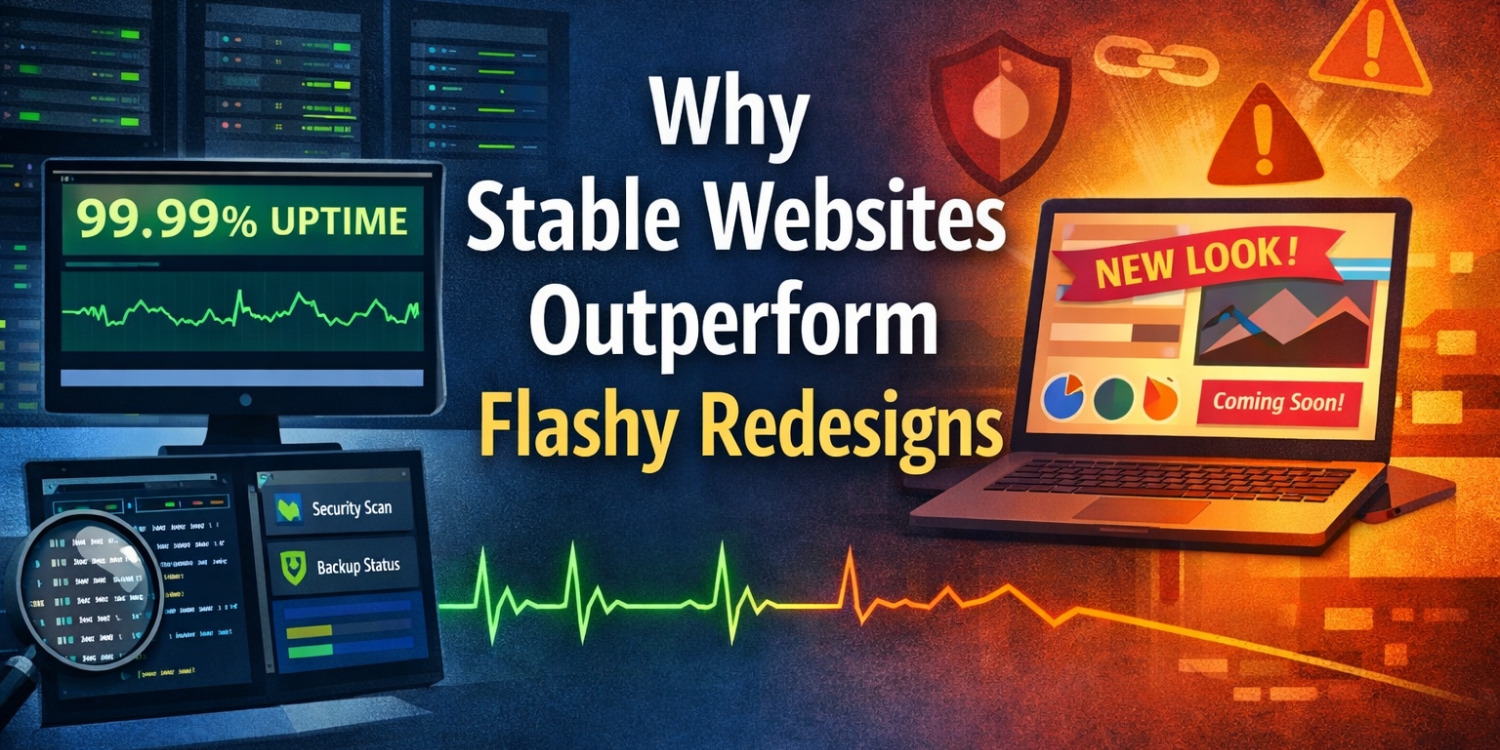
Most websites do not fail in dramatic fashion. There is no explosion, no warning siren, no obvious moment where everything breaks. They fail quietly.
A form stops sending emails. Pages load a little slower every month. Search rankings drift downward without explanation. Backups begin failing, but no one notices. A plugin update introduces a warning that never surfaces on the frontend, yet slowly poisons performance. By the time the problem is visible, the damage has already been done.
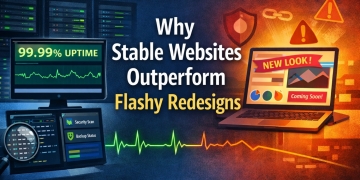
This is why stable websites consistently outperform flashy redesigns.
I have watched businesses spend thousands of dollars on a new look while their underlying problems remained untouched. A fresh theme went live. New fonts. New colors. A cleaner layout. For a few weeks, everything felt better. Then the same old issues returned because nothing fundamental had changed. The site was still neglected, still unmonitored, still vulnerable, just wearing new clothes.
A website is not a brochure. It is not a poster. It is a living system that runs every hour of every day, whether anyone is paying attention or not.
The Illusion of Progress
Redesigns feel productive. They are visible. You can point to them. You can show them to people. They create a sense of motion and improvement even when the core problems remain untouched.
Stability work is the opposite. When done correctly, nothing appears to happen. Pages keep loading. Emails keep sending. Traffic keeps flowing. There is no celebration for a server that did not crash, no applause for a security hole that was quietly closed before it could be exploited.
Because of this, stability is often undervalued until it is gone.
I have been brought in after redesigns that were supposed to solve everything. The business owner was confused. The site looked better than ever, but conversions were down. Search rankings were slipping. Customers were complaining about broken features. In every case, the issues had nothing to do with design and everything to do with neglect.
A new design cannot fix an expired SSL certificate. It cannot restore a corrupted database. It cannot compensate for a server that is starved for memory or disk space. It cannot make up for years of unchecked updates and ignored warnings.
Design is a layer. Stability is the foundation.
What Stability Actually Means
Stability is not a single task. It is not a plugin. It is not a one time setup. It is an ongoing responsibility.
A stable website is one where someone is actively watching what most people never see. Server health. Error logs. Disk usage trends. Backup reports. Security alerts. Update compatibility. Performance metrics over time.
These are not glamorous things. They do not make for exciting screenshots. Yet they determine whether a website quietly supports a business or slowly undermines it.
Stability means knowing when something changes, not weeks later, but when it happens. It means catching problems early, when they are small and cheap to fix. It means understanding the site well enough to recognize when something feels off even if there is no obvious error.
This is not automated maintenance in the marketing sense. Automation helps, but it does not replace experience. Alerts still need interpretation. Logs still need human eyes. Context still matters.
A warning that looks harmless on one site might be catastrophic on another. A plugin update that works fine today might conflict with a custom function written years ago. A server with plenty of free disk space today might be on a slow path to failure due to log growth or backups piling up silently.
Stability is awareness.
The Cost of Quiet Failures
The most dangerous website problems are the ones that do not announce themselves.
I have seen contact forms fail for months before anyone noticed. Leads were being submitted. Emails were never sent. The business assumed interest had dried up. In reality, the site was swallowing opportunities without making a sound.
I have seen backups fail because a storage location filled up. The site continued running perfectly until the day it crashed. At that moment, everyone discovered there were no usable backups. What should have been a minor recovery became a catastrophe.
I have seen security issues linger because alerts were being emailed to an inbox no one checked anymore. The site was not hacked immediately. Instead, it was quietly abused, sending spam or hosting malicious scripts in hidden directories, slowly damaging its reputation with search engines.
These failures do not appear on the homepage. They live behind the scenes. They erode trust and performance over time until the damage becomes visible in revenue, rankings, or credibility.
Flashy redesigns do nothing to prevent these problems.
Design Ages Faster Than Stability
Design trends move quickly. What looks modern today will look dated in a few years. This is normal and expected.
Stability, however, ages differently. A well maintained website from five or even ten years ago can still perform beautifully if its foundation has been cared for. Clean code, updated dependencies, secure configurations, and attentive administration do not expire the way design trends do.
I have worked on websites that looked plain by modern standards but were rock solid. They loaded fast. They ranked well. They converted visitors consistently. Their owners resisted unnecessary redesigns and invested instead in keeping the site healthy.
Those sites outperformed prettier competitors because they worked.
Users forgive simple design far more readily than they forgive broken functionality, slow load times, or security warnings. Trust is fragile. Once lost, it is difficult to regain.
Ownership Versus Outsourcing Responsibility
One of the most common problems I see is unclear ownership. Everyone assumes someone else is watching the site.
The designer believes the host is handling security. The host assumes the developer is managing updates. The developer assumes the client will notice if something breaks. The client assumes everything is fine because the site is still online.
In reality, no one is responsible.
Stability requires clear ownership. Someone must be accountable for the health of the system as a whole. Not just parts of it. Not just when something goes wrong. Continuously.
This is where many businesses get trapped in cycles of redesigns. When problems appear, they assume the site is outdated and needs to be rebuilt. They replace the visible layer instead of addressing the invisible responsibilities that were never assigned in the first place.
A stable website has a caretaker. Someone who knows its history. Someone who understands why certain decisions were made. Someone who remembers past issues and prevents them from returning.
Security Is Not a Feature
Security is often treated as a checkbox. Install a plugin. Enable a firewall. Assume the problem is solved.
In reality, security is a process. Threats change. Software evolves. Attack methods adapt. What was safe last year may be vulnerable today.
Flashy redesigns rarely improve security. Sometimes they make it worse by introducing new dependencies, untested code, or rushed configurations. A redesign that focuses on appearance without understanding the underlying system can open doors that were previously closed.
True security comes from attention. Monitoring login attempts. Reviewing logs. Updating responsibly. Removing abandoned plugins. Locking down permissions. Understanding the server environment, not just the CMS.
Security also includes knowing when to remove things. Old code. Old accounts. Old integrations that are no longer needed. Every unused component is a potential liability.
A stable website is not one that never gets attacked. It is one that is prepared, watched, and resilient.
Performance Is Cumulative
Performance problems rarely appear overnight. They accumulate.
An extra script here. A tracking pixel there. A plugin added for a temporary purpose that never gets removed. Over time, these small decisions add weight. Pages become heavier. Queries become slower. Server load increases.
A redesign might temporarily improve performance by cleaning up the front-end, but without ongoing discipline, the same decay begins again.
Stability focused administration watches performance trends, not just snapshots. It notices gradual slowdowns. It identifies patterns. It addresses root causes instead of chasing symptoms.
A fast website is not achieved once. It is maintained.
The Myth of Starting Fresh
There is a belief that rebuilding from scratch solves complexity. Sometimes this is true. Often it is not.
Rebuilds discard history. They remove the context that explains why things are the way they are. They reset problems instead of solving them.
I have seen rebuilt sites reintroduce the same mistakes because the underlying causes were never understood. The same integrations. The same workflows. The same assumptions. Just rewritten.
Stability work values continuity. It improves what exists. It respects the reality that business critical websites evolve over time. They carry data, users, integrations, and expectations that cannot simply be wiped away without consequence.
Starting fresh feels clean. Maintaining something real is harder. It is also far more valuable.
Why Businesses Underestimate Administration
Administration is invisible when done well. That is its curse.
There is no launch day. No reveal. No applause. Just quiet reliability.
Because of this, administration is often undervalued until it disappears. Only when a site goes down, data is lost, or trust is damaged does its importance become clear.
Businesses readily budget for redesigns because they are tangible. They hesitate to invest in administration because it feels abstract. Yet one protects the future while the other mostly reshapes the present.
A stable website compounds value. Each month of consistent operation builds trust with users and search engines. Each year of careful maintenance reduces risk and increases confidence.
Flashy redesigns offer short bursts of attention. Stability offers longevity.
The Long Term View
Websites that last are not the ones that chase every trend. They are the ones that are cared for.
They have someone watching them at odd hours. Someone who notices small changes. Someone who understands that prevention is cheaper than recovery.
They prioritize uptime over novelty. Reliability over reinvention. Responsibility over appearance.
This does not mean design does not matter. It does. A site should be usable, clear, and appropriate for its audience. But design should serve stability, not replace it.
When design becomes the focus at the expense of administration, the website becomes fragile. When stability leads and design supports it, the website becomes an asset instead of a liability.
Why I Focus on Stability Now
After decades of working on websites, the pattern is clear. The sites that succeed are not the prettiest. They are the ones that stay online, stay secure, and stay functional year after year.
I now focus on administration and cybersecurity for existing, business critical websites because that is where the real value lies. Not in constant reinvention, but in stewardship.
These are sites that already matter. They already serve customers. They already represent reputations. They deserve care, not cosmetic resets.
Stability is not exciting. It is not flashy. It is not easily summarized in a screenshot.
It is, however, the reason some websites quietly outperform others while no one is looking.
And in the long run, quiet reliability wins.