













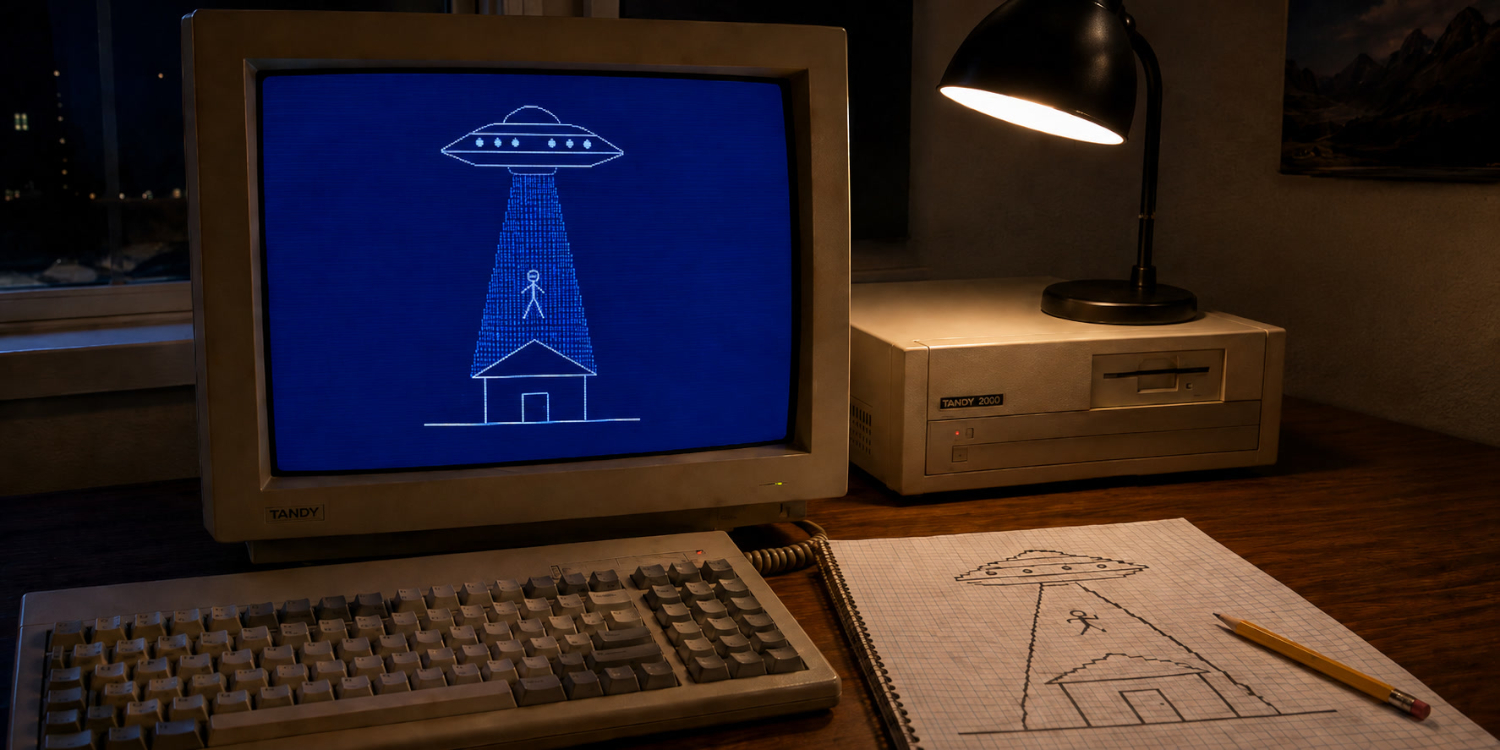
My first real introduction to programming came through BASICA and GWBASIC on a Tandy 2000 my father got in 1990 by trading a spotlight to a neighbor down the road. I was 10 years old, and that machine gave me something I had not felt before. It was not just a computer I could use. It was a computer I could talk to in a way that changed what appeared on the screen.
A lot of my early learning came from looking through the code for games and programs on the 5.25 inch floppy disks that came with the computer. It also came with an operating manual that included a section on BASIC programming, and I spent time with that too. I was curious enough to open things up and see how they worked, even when I did not fully understand what I was looking at yet. That habit mattered because it taught me to treat code as something I could inspect, not something sealed off from me. I learned a lot just by reading, testing, and changing things to see what happened.
What pulled me in was not printing words or doing simple math. It was the moment I realized I could make the screen do something visual. Once I understood that I could place shapes, points, and movement there with code, the whole thing stopped feeling like schoolwork and started feeling creative. That mattered a lot, because I was not looking for a lecture. I was looking for something that felt alive.
I did not have the vocabulary then to describe why it was so exciting. I just knew that typing instructions and seeing the result appear right in front of me felt different from almost anything else I had done. It also helped that I was learning from real code instead of only invented classroom examples. That combination of curiosity, experimentation, and immediate feedback stayed with me. It is still one of the clearest examples I can think of for why direct feedback matters so much when someone is learning to program.
Why Grid Paper Became Part Of The Process
One of the things I enjoyed most was recreating pictures with grid paper before I ever tried to draw them on the screen. I would break an image down into smaller pieces and treat each square like part of a plan. That gave me a way to think about position and shape before I had to think about code. It slowed the idea down enough that I could make sense of it.
Grid paper turned pictures into something more manageable. A roof line stopped being a vague outline and became a set of points and edges. A stick figure stopped being a person and became a head, a body, and a few lines placed in the right spots. That may sound simple now, but it was teaching me one of the most useful lessons in programming. Large things become less intimidating when you can break them into smaller parts.
I was also learning that the computer did not understand my intent. It only understood exactly what I gave it. If I wanted something centered, I had to decide what centered actually meant. If I wanted the left side to match the right side, I had to make the numbers support that. That kind of thinking did not feel like theory. It felt like practical problem solving.
Looking back, grid paper was one of my earliest design tools. I was planning before I was coding, even if I did not think of it that way at the time. It helped me see that the screen was not random space. It was a mapped surface, and every picture on it had to be translated into coordinates with enough care that the machine could reproduce what I had in mind.
Drawing Pictures Taught Me To Be Precise
Once I moved from paper to screen, I learned quickly that close was not the same as correct. A line that was slightly off could distort an entire object. A point in the wrong place could make something look uneven, crooked, or broken. The computer was not being unfair. It was showing me exactly where my thinking had not been clear enough yet.
I spent time drawing houses, stick figures, and more detailed vehicles, and all of them taught the same lesson in different ways. Simple shapes made mistakes easier to spot, which was useful. A roof that did not meet cleanly or wheels that sat at the wrong height made the problem obvious. That kind of feedback helped me learn faster because the error was visible instead of hidden.
Programming became a lesson in precision long before I understood bigger concepts like architecture or abstraction. It taught me that small values matter, order matters, and consistency matters. Those are not glamorous lessons, but they are some of the most durable ones I took with me. A lot of later programming work still comes down to whether I paid enough attention to the details that hold the whole thing together.
10 SCREEN 1
20 LINE (20,100)-(60,100)
30 LINE (20,100)-(20,70)
40 LINE (60,100)-(60,70)
50 LINE (20,70)-(60,70)
60 LINE (20,70)-(40,50)
70 LINE (40,50)-(60,70)
Animation Was Where It Really Came Alive
Drawing pictures was fun, but animation was where everything changed for me. A static image was satisfying because it proved I could build something. Motion made it feel like I was creating behavior. That difference is hard to overstate, because once I saw something move across the screen, programming stopped feeling like it was limited to shapes and started feeling like it could tell a story.
I used to animate UFOs flying across the screen, tornadoes blowing away houses and stick figures, and vehicles driving from one side to the other. The UFO scenes were some of my favorites because I kept adding to them. It was not enough to make a saucer drift across the display. I wanted blinking lights, little aliens inside, lasers shooting downward, and a stick figure below getting zapped up into the ship.
That is the part that still makes me smile now, especially with UFO and UAP talk picking up again in 2026. At 10 years old, I was not thinking about trends or headlines. I was thinking about how to make the scene feel more alive in front of me. Every extra detail pushed me to figure out one more programming problem before I could get the effect I wanted.
That was exciting partly because it felt creative, but it was also educational in a way I did not appreciate until much later. The moment an object moved, I had to think about what happened next and then what happened after that. I had to think about order. I had to think about what changed and what stayed in place. I had to think about how to make motion look intentional instead of accidental.
The tornado idea especially stands out to me because it added more than movement. It added interaction. It was not enough to move one object across empty space. I wanted motion to affect something else on the screen. That meant I was beginning to think about scenes, timing, and relationships between objects long before I knew those were the kinds of ideas that show up all over modern programming.
The vehicle animations taught me something slightly different. A more detailed object forced me to care about structure while it was moving, not just while it was standing still. A car or truck that looked fine in one position could fall apart visually if I did not redraw it carefully during motion. That taught me to respect the difference between a good idea and a well-executed one.
I still think that kind of experimentation is one of the best ways to get someone interested in programming. It gives them a reason to keep going. They are not just trying to satisfy a lesson plan. They are trying to make something happen. That shift in motivation matters, because curiosity carries people through frustration better than obligation ever will.
Animation Taught Me Loops, Timing, And Sequence
Animation also taught me some of my first real programming lessons in a form I could actually understand. A loop stopped being an abstract structure and became the thing that moved a UFO across the screen. Sequence stopped being a vague concept and became the reason an object moved correctly or broke apart. Timing stopped being invisible and became the difference between something smooth and something impossible to follow.
When I animated something, the process had to make sense in order. Draw the object. Move the position. Clear or redraw the screen. Draw it again. Pause just enough that the movement could be seen. Repeat until the sequence was complete. Once I started adding things like blinking lights, a laser beam, and a stick figure waiting on the far side of the screen, the sequence mattered even more because different parts of the scene had to appear at the right moment.
What I liked about BASIC was how little distance there was between the instruction and the result. If a loop ran too long, I saw it. If the object moved in the wrong direction, I saw it. If the delay was off, I saw it. That direct relationship between the code and the behavior made the lessons stick in a way that would have been harder with heavier tools around me.
The same thing was true with repetition. A repeated action makes a lot more sense when it creates motion than when it sits on a worksheet as a definition. I did not need someone to convince me loops were important. The value was right there on the screen. If I wanted a vehicle to cross from left to right, a loop was no longer optional. It was the structure that made the whole idea possible.
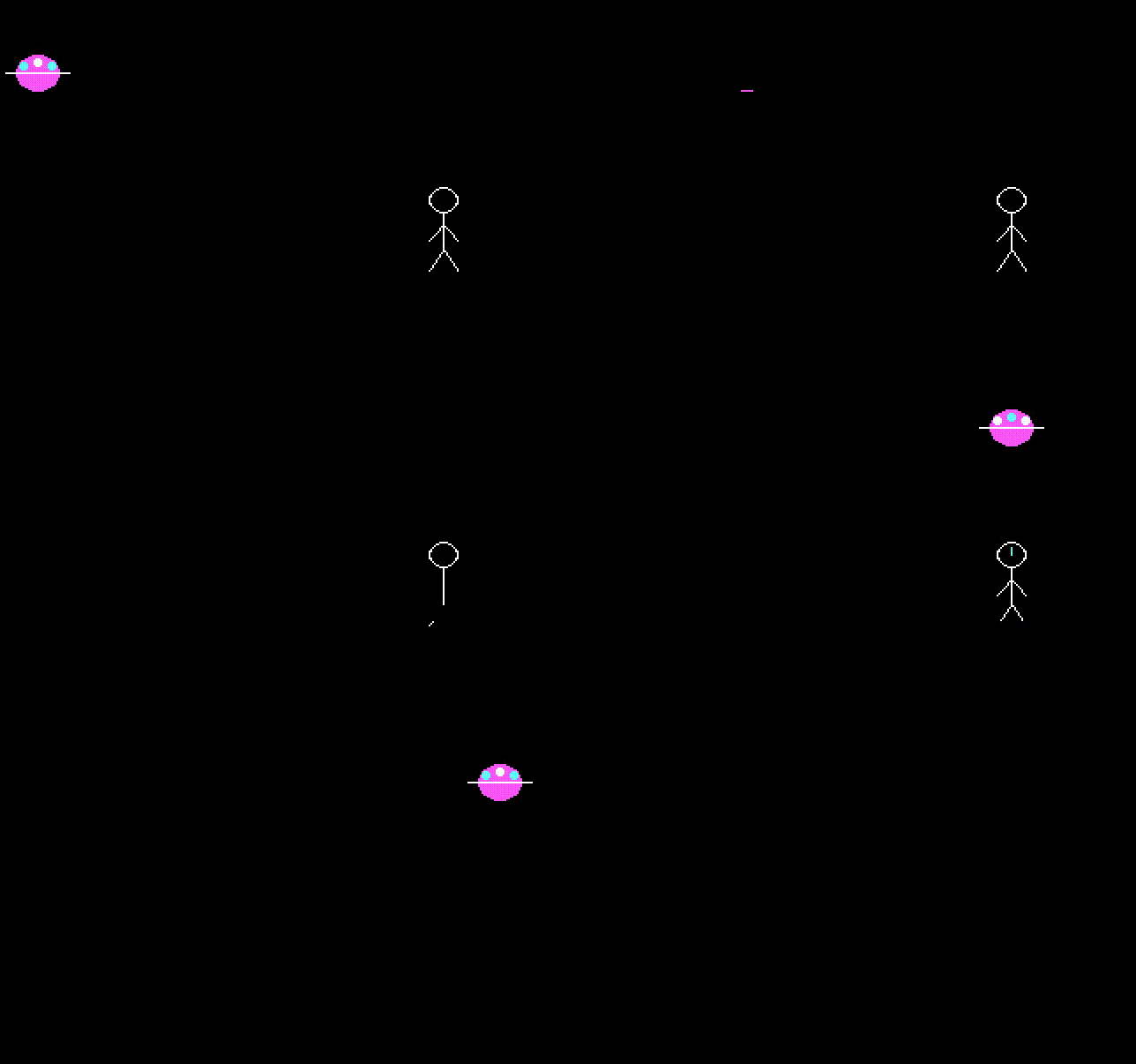
Here is a preview of that UFO sequence in progress. It captures the kind of animated scene I was building, with the ship moving in, the beam dropping, and the stick figure getting pulled up before the UFO takes off again.
10 SCREEN 1
20 SX = 250
30 SY = 112
40 B = 1
50 FOR UX = 20 TO SX STEP 4
60 CLS
70 GOSUB 300
80 GOSUB 400
90 FOR D = 1 TO 120: NEXT D
100 NEXT UX
110 UX = SX
120 FOR Y = SY TO 60 STEP -4
130 CLS
140 GOSUB 300
150 GOSUB 400
160 LINE (UX,Y)-(UX,SY),1
170 SY = Y
180 FOR D = 1 TO 120: NEXT D
190 NEXT Y
200 FOR UX = SX TO 400 STEP 4
210 CLS
220 GOSUB 400
230 FOR D = 1 TO 120: NEXT D
240 NEXT UX
250 END
300 CIRCLE (SX,SY),8,3
310 LINE (SX,SY+8)-(SX,SY+28),3
320 LINE (SX,SY+14)-(SX-8,SY+23),3
330 LINE (SX,SY+14)-(SX+8,SY+23),3
340 LINE (SX,SY+28)-(SX-8,SY+40),3
350 LINE (SX,SY+28)-(SX+8,SY+40),3
360 RETURN
400 IF B = 1 THEN C1 = 1 ELSE C1 = 3
410 IF B = 1 THEN C2 = 3 ELSE C2 = 1
420 CIRCLE (UX,40),12,2
430 PAINT (UX,40),2,2
440 LINE (UX-18,40)-(UX+18,40),3
450 CIRCLE (UX-8,36),2,C1
460 PAINT (UX-8,36),C1,C1
470 CIRCLE (UX,34),2,C2
480 PAINT (UX,34),C2,C2
490 CIRCLE (UX+8,36),2,C1
500 PAINT (UX+8,36),C1,C1
510 IF B = 1 THEN B = 0 ELSE B = 1
520 RETURN
Debugging Became Something I Could See
One of the best things about learning this way was that bugs were often visible immediately. If a UFO jumped instead of gliding, I knew something in the movement logic was off. If a tornado erased the wrong part of a house, I knew the redraw was wrong. If a vehicle looked solid in one frame and broken in the next, I knew I had not handled the object consistently.
That taught me to observe before guessing. I learned to watch what the program was actually doing instead of only thinking about what I meant for it to do. That sounds basic, but it is still a useful discipline. A lot of debugging improves when I stop arguing with the problem and start paying attention to its actual behavior.
It also taught me not to panic when something looked wrong. Visual mistakes felt fixable because I could usually narrow them down. A coordinate might be off. A loop range might need adjustment. A redraw step might be happening too early or too late. Those early corrections trained me to think in small changes, and that is still one of the most reliable ways I know to debug anything.
I do not think I would have learned that as quickly from dry examples. Watching a mistake happen on the screen made the lesson immediate. It removed some of the mystery and replaced it with evidence. That made programming feel less like magic and more like a system I could learn to reason through.
Even now, a lot of my problem solving still works that way. Whether I am writing code, tracking down a server issue, or working through a WordPress problem, I want to observe the behavior clearly before I start changing things. That habit did not begin with modern tools. It started when a shape landed in the wrong place on a BASIC screen and I had to figure out why.
Those Early Experiments Still Affect How I Think
The tools I use now are obviously different, but the thinking patterns are not as different as people might expect. I still break ideas into smaller pieces before I try to solve them. I still care about how one moving part affects another. I still pay attention to whether the problem is in the structure, the sequence, or one small value that is throwing everything off.
That early drawing and animation work also shaped how I think about systems I can observe clearly. Layout, motion, user flow, and feedback all make more sense when I can picture what is happening instead of treating it as an abstract chain of events. Even when I am working on something less visual, I still tend to think in terms of state, position, and sequence. That habit goes back much farther than the languages I use today.
I also think those early experiments built patience in a useful way. They taught me that a result can be interesting even when the process is repetitive. You move the object again, adjust the value again, redraw the shape again, and eventually the program starts behaving the way you hoped it would. That kind of patience turns out to be valuable whether I am writing a script, debugging an application, or cleaning up a difficult server problem.
Another thing that stayed with me is the value of making ideas testable as soon as possible. When I can see the result of a change, I learn faster. That may mean drawing on a screen, logging output, watching a request, checking a file, or observing a system under load. The principle is the same. The sooner I can connect an instruction to a clear effect, the sooner I can understand what is really happening.
That is part of why I still respect simple experiments. A lot of technical work becomes easier when the problem is reduced to something small enough to observe clearly. BASIC taught me that in a very direct way. I did not need a giant system to learn good habits. I needed a machine, some curiosity, and a reason to keep making one more thing move across the screen.
Why Simple Tools Can Be Great Teachers
One reason BASIC was such a good teacher is that there was very little hiding the cause and effect. I could type something, run it, and see what changed right away. If it worked, I knew why well enough to keep building. If it failed, I usually had enough evidence to start narrowing down the problem.
That kind of simplicity matters when someone is learning. It removes some of the distance between the concept and the result. Modern tools are powerful, and I use them constantly, but there is still something valuable about an environment where the behavior is exposed so clearly. It is hard to ignore a lesson when the machine answers you immediately.
I do not think every beginner needs to start with old BASIC to learn well. I do think there is a real advantage to simple tools that make structure visible and experimentation easy. BASICA and GWBASIC did that for me. They gave me a place where curiosity could turn into practice without too much friction in the way.
10 SCREEN 1
20 FOR X = 30 TO 120 STEP 10
30 PSET (X,40)
40 NEXT X
Why I Still Value That Beginning
When I look back on BASICA and GWBASIC now, I do not value them because they were old. I value them because they gave me a direct way to learn how programming behaves. Drawing and animating on the screen taught me how to plan, how to observe, how to correct mistakes, and how to keep going when an idea was not working yet. Those are not small lessons.
They also made programming feel creative from the start, and I think that matters more than people admit. It is easier to stay engaged when the work feels like making something instead of only memorizing rules. For me, pictures and animation turned logic into something I could enjoy. That enjoyment is a big part of what kept me learning long enough for the deeper lessons to take hold.
I still carry that beginning with me because it shaped how I approach technical work now. Learn the system. Watch what it does. Break the problem down. Adjust one piece at a time. Those habits were already forming when I was using grid paper to plan drawings and trying to get a UFO to move across a DOS screen the way I pictured it in my head.
That is why those early BASIC experiments still matter to me. They were simple, but they taught real programming lessons in a form I could understand. Drawing and animating on the screen made logic feel concrete, and once it clicked, I wanted to keep learning. I do not think I ever really stopped.